
Most project teams understand that BIM coordination is important. Fewer understand what it actually involves, what a proper package delivers, and why two providers can quote the same job at completely different prices. This guide covers the process start to finish — what happens at each stage, what you should be receiving, and what it should cost.
No acronym soup. No sales pitch. Just the process as it works on a real project, with the details that separate a coordination exercise that protects your project from one that produces a report and leaves the risk on site.
What BIM Coordination Actually Is
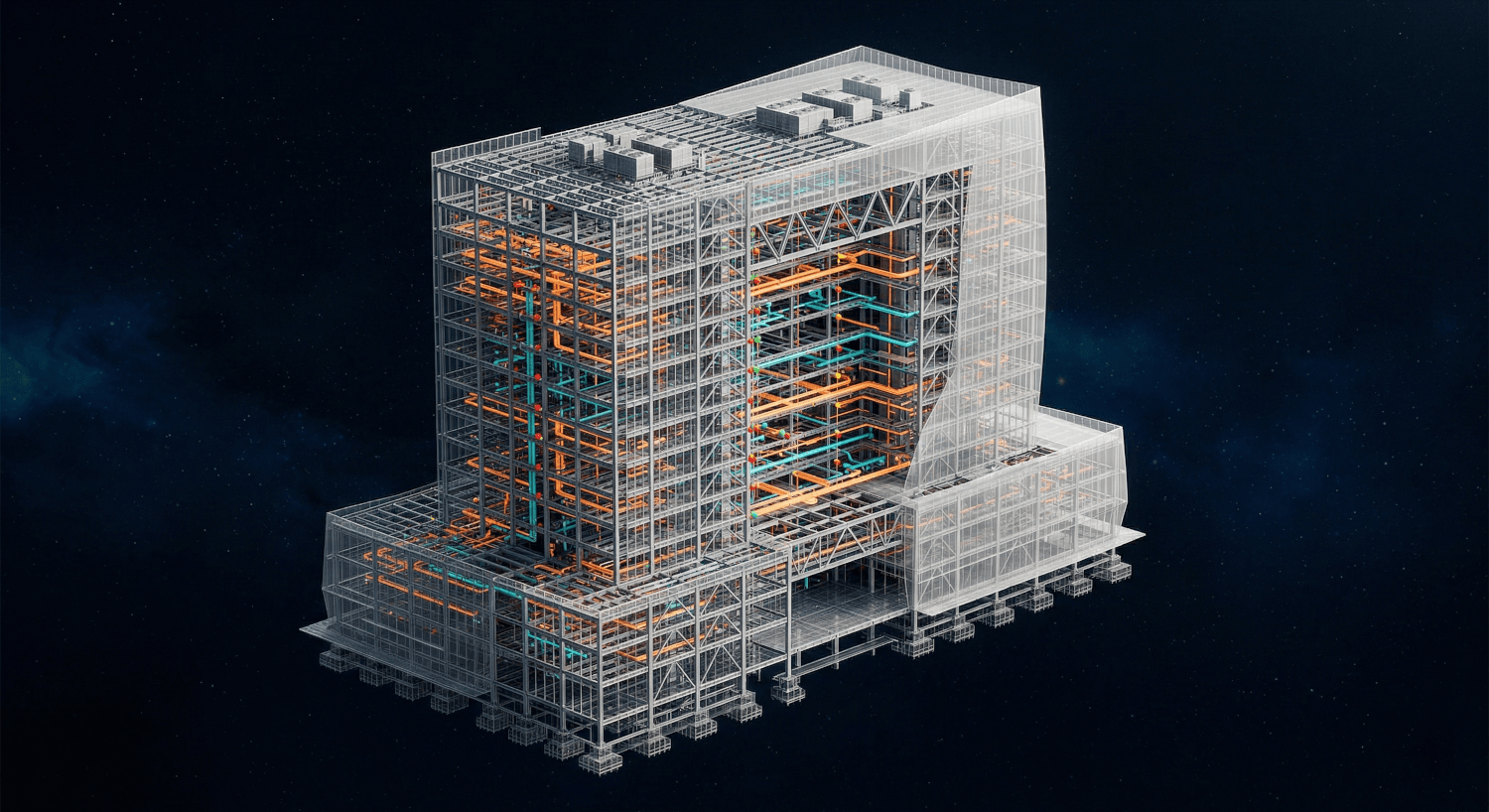
BIM Coordination is the process of combining the separate discipline models — architectural, structural, mechanical, electrical, plumbing — into a single federated file, running systematic tests to identify conflicts between those systems, and driving every conflict to a documented resolution before construction documentation is issued.
The key word is process. Coordination is not a software tool. Navisworks, Solibri, and BIM 360 are instruments — the same way a scalpel is an instrument. What produces a good outcome is the methodology, the tolerance calibration, the issue management, and the resolution tracking. A poorly run coordination exercise with good software produces a long list of clashes and no accountability for fixing them. That is not coordination — it is a noise generator.
A well-run coordination package produces a clean, buildable federated model with a documented sign-off that your QS can reference against any future variation claim.
Typical clashes found on an uncoordinated mid-rise commercial project
Average RFI reduction on InfinevoD-coordinated projects
First clash report from model receipt to delivery
The Four-Stage Process
Every serious coordination engagement follows the same four stages. The quality of the outcome depends on how rigorously each one is executed — particularly stage one, which most providers rush or skip entirely.
Model Audit and Setup
Every file is checked for LOD compliance, shared coordinate alignment, and naming convention consistency before federation. This step is where most coordination failures actually start — a model that looks correct in isolation can produce thousands of false-positive clashes when combined with a file on a different coordinate origin.
Discipline Federation
Architectural, structural, and MEP models are combined into a single Navisworks or ACC federated model. Clash tolerances are agreed per discipline pair before any tests are run — the tolerance between structural steel and mechanical ductwork is not the same as between plumbing and electrical conduit.
Clash Detection and BCF Issue Log
Automated tests run across all discipline pairs. Results are triaged by severity — hard clashes where elements physically overlap, clearance clashes where maintainability is compromised, soft clashes within warning zones. Delivered as a prioritised BCF log with camera views, element IDs, severity ratings, and suggested resolution paths.
Resolution Tracking and Sign-Off
Issues are assigned to responsible disciplines via the project CDE. The coordinator tracks every open item through to resolution, running new clash cycles to confirm fixes and catch any new conflicts introduced by the remediation. A coordination sign-off certificate is issued when the model is clean.
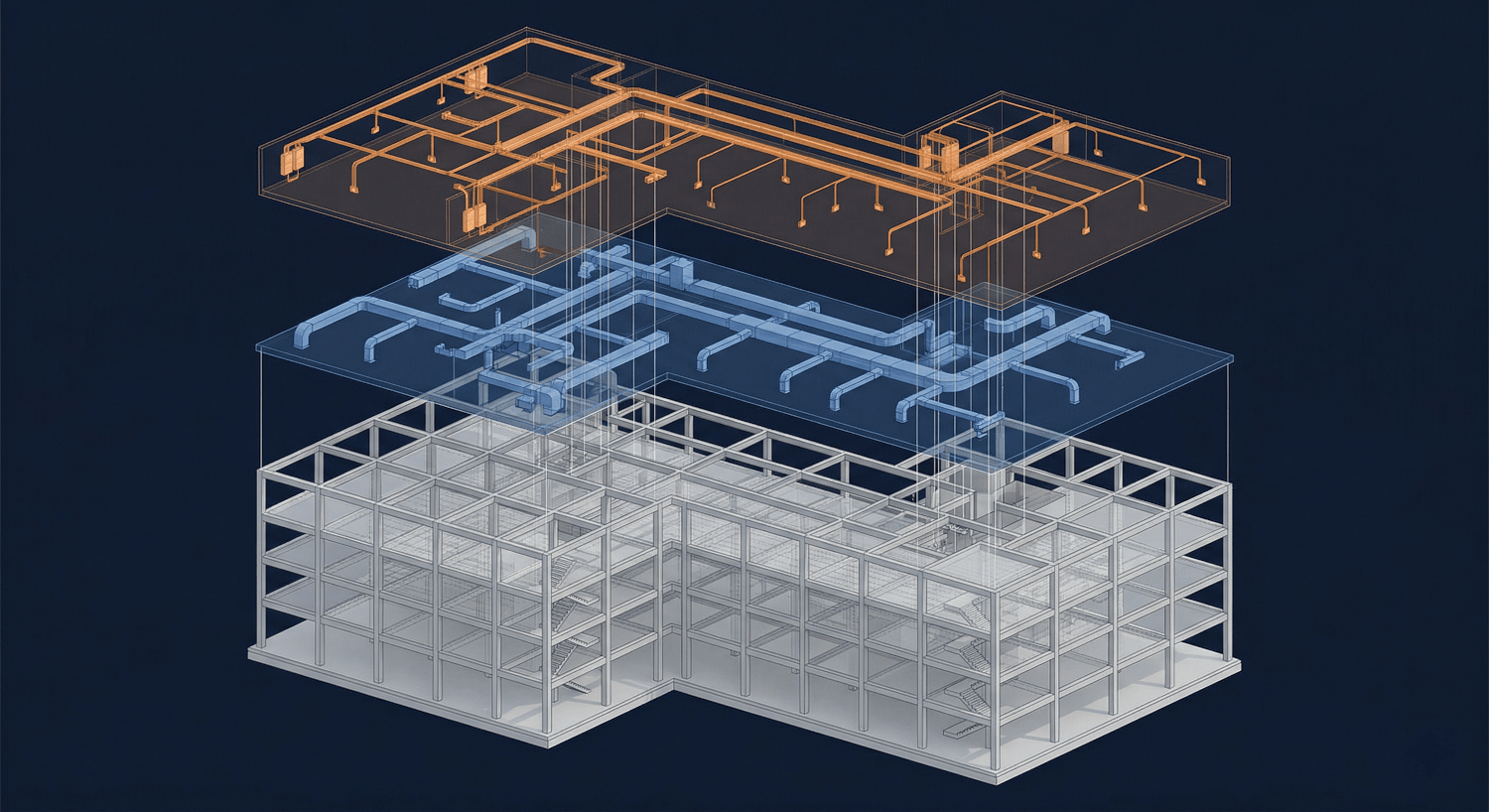
Three discipline layers combined in a federated model — the view a coordinator works from during clash detection and resolution.
What Gets Clashed Against What
Understanding the discipline pairs helps project teams brief their coordination provider accurately and understand why certain clashes are flagged as critical while others are advisory.
Structural vs MEP — the highest-value clash category. A beam through a duct, a column through a pipe run. These are hard clashes that stop construction completely if discovered on site.
Architectural vs Structural — walls, slabs, and openings that do not match the structural model. Common in projects where the architectural package was updated after the structural design was issued.
Mechanical vs Electrical — ductwork and cable trays competing for the same ceiling void. The most voluminous clash category on dense commercial projects.
MEP vs MEP — mechanical, electrical, and plumbing sub-disciplines tested against each other. Routinely accounts for 40 to 50% of all clashes on coordinated projects.
Clearance clashes — elements not physically touching but too close for safe maintenance access. A valve with no wrench clearance. A cable tray that can never be inspected. These do not show up in a hard-clash-only test but create operational problems from day one of occupation.
Not Sure What Your Models Are Worth Coordinating?
Send them to us. We run a free audit — no obligation — and tell you the current LOD, coordinate alignment status, and our estimate of the clash volume before you commit to anything.
What a Proper Coordination Package Includes
A coordination package is not just a clash report. If that is all you are receiving, you are getting the easy part and paying for the hard part yourself — in the form of unmanaged issues, untracked resolutions, and no documentation trail when disputes arise.
- BCF issue log with camera views, element IDs, severity classifications, and suggested resolution path for each clash
- Issue tracking through resolution cycles — not just flagging, but following every open item to closure
- Coordination sign-off certificate on completion — a document your QS can reference against any future variation
- COBie data extraction if the project has FM handover requirements — a by-product of coordination, not a separate exercise at practical completion
What It Costs
BIM coordination should be priced on a fixed fee after a model audit — not hourly. Hourly pricing creates the wrong incentive and makes cost forecasting impossible for project managers who need to commit a budget.
At InfinevoD, pricing after a free model audit typically works out as follows: small projects up to 1,000m² from £2,000; mid-size projects from 1,000 to 5,000m² from £4,000 to £10,000; large schemes from £10,000. The fee is set after reviewing the actual model files — not based on a floor area formula, because the real variable is model maturity, not building size.
”We had been running the same coordination process for six years and thought it was fine. InfinevoD ran our first coordinated project, found 340 clashes, and we had zero coordination-related RFIs on site. We have not gone back to the old way.”
— BIM Manager, Tier 1 Contractor, UK
Starting a project in the next 8 weeks?
Tell us the project type, programme, and what discipline models you currently have. We will scope the coordination package and come back with a fixed fee within 24 hours.
Frequently Asked Questions
First clash report: 3 to 5 working days from model receipt. Full resolution cycle including one round of re-coordination after fixes: 1 to 2 weeks. Complete sign-off on a multi-storey scheme: 4 to 8 weeks depending on issue volume and how quickly the responsible disciplines respond to open items.
No — and earlier is always better. We can run coordination on works-in-progress models and flag missing or incomplete areas as part of the audit. The most expensive clashes are the ones that reach site. Even a partial model review has real value.
We work natively in Revit (.rvt) and accept IFC, NWC, NWD, DWG, and DGN. If your team is on a non-Autodesk platform, contact us — we handle most major BIM authoring tools and can advise on the cleanest export format for coordination purposes.
Yes. We work with in-house BIM teams regularly — either supplementing capacity during peak phases or providing an independent coordination check before key stage gates. We adapt to your workflow, CDE, and naming conventions rather than requiring you to change anything.
The Short Version
BIM Coordination is a process, not a software. The value comes from rigorous execution — correct tolerance calibration, systematic issue tracking, and documented sign-off — not from which platform runs the clash test.
InfinevoD has run BIM coordination on over 500 projects across the UK, Middle East, Australia, and North America. We start within 5 working days, work on a fixed fee, and every engagement begins with a free model audit. If you have models and a programme to protect, contact us today.