

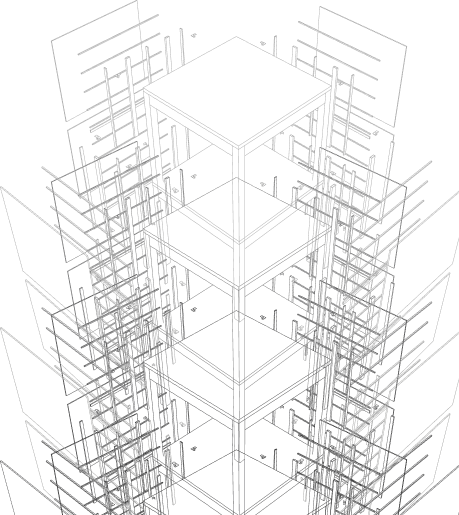
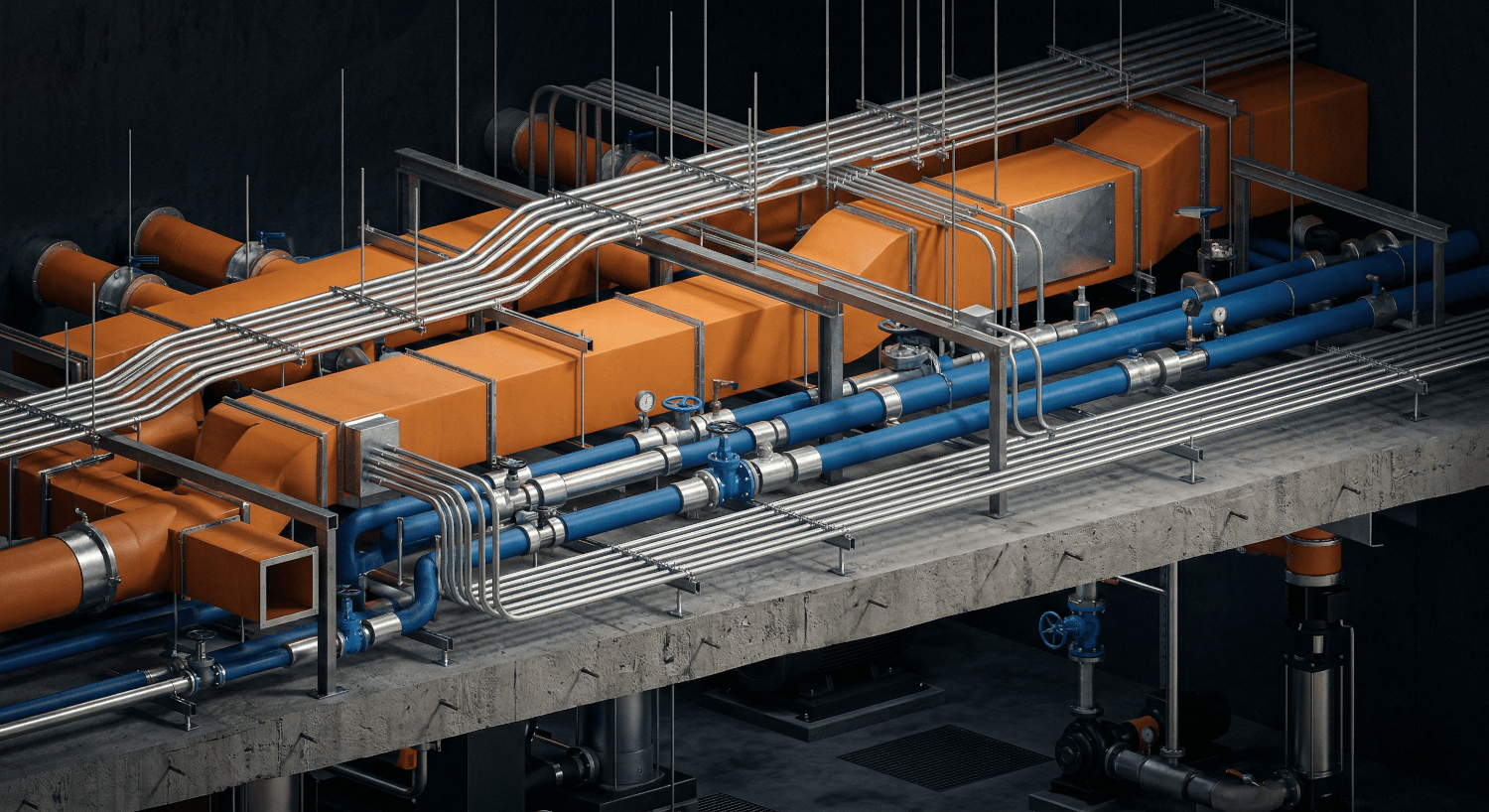
MEP modeling failures rarely happen because the software was wrong or the team was incompetent. They happen because of four specific process problems that repeat on project after project. Each one is entirely avoidable. Each one, left unchecked, turns into RFIs, variations, and programme slippage that the project team absorbs while trying to work out where the coordination process broke down.
Mistake 1: Modeling Against the Wrong Revision
The structural package is issued. The MEP team takes it, starts routing ductwork and pipe runs, and builds their model against that revision. Three weeks later the architect issues a revision — a rearranged plant room, relocated core walls, adjusted slab openings. The MEP team either does not receive it promptly, or receives it but does not update the model immediately, or updates it but does not re-coordinate against the new structural file that was simultaneously updated to reflect the same change.
When the federated model is assembled for the first coordination meeting, nothing aligns. MEP is routing through walls that no longer exist. Ductwork passes through structural elements added in the latest revision. The coordination team spends two days triaging clashes that are entirely attributable to version mismatch — not to any real design conflict.
The fix is a model exchange protocol established at project start. Who issues updated files, to whom, on what schedule, and what the acceptance criteria are before a discipline starts routing against a new revision. Simple to agree on week one. Nearly impossible to retrofit on week eight.
”Sixty percent of the clashes we see on first coordination are not design clashes — they are version control clashes. The design would have been fine if everyone had been working from the same revision.”
— InfinevoD Lead Coordinator
Mistake 2: LOD Creep in the Wrong Direction
Level of Development (LOD) describes how much information and geometric detail a model element contains. LOD 200 is a placeholder — approximate size and location. LOD 350 includes the information needed for coordination and construction. LOD 400 includes fabrication-level detail for manufacturing.
The mistake appears in two forms. First: MEP teams modeling at LOD 400 in stage D before routing is even confirmed, spending days on valve handle geometry and bracket details while the architectural team has not yet issued the ceiling coordination drawing. The model is technically impressive and practically useless — it will need to be rebuilt when the design develops.
Second: LOD 200 placeholders handed to a coordination team expected to run meaningful clash tests. A block representing a fan coil unit at approximate size tells the coordinator nothing about whether the installation will fit, clear the structural beam above it, or allow maintenance access. Coordination against LOD 200 MEP produces results that are not actionable.
The right LOD at each stage: LOD 300 for design coordination, LOD 350 for construction coordination and clash detection, LOD 400 for shop drawing and prefabrication packages only. Agreeing this in the BIM Execution Plan at project start removes the ambiguity that causes both failure modes above.
MEP Models in Progress? Run a Free Coordination Audit.
Send us your current MEP and structural files. We check LOD compliance, coordinate alignment, and run a first-pass clash test. Report in 48 hours — no charge.
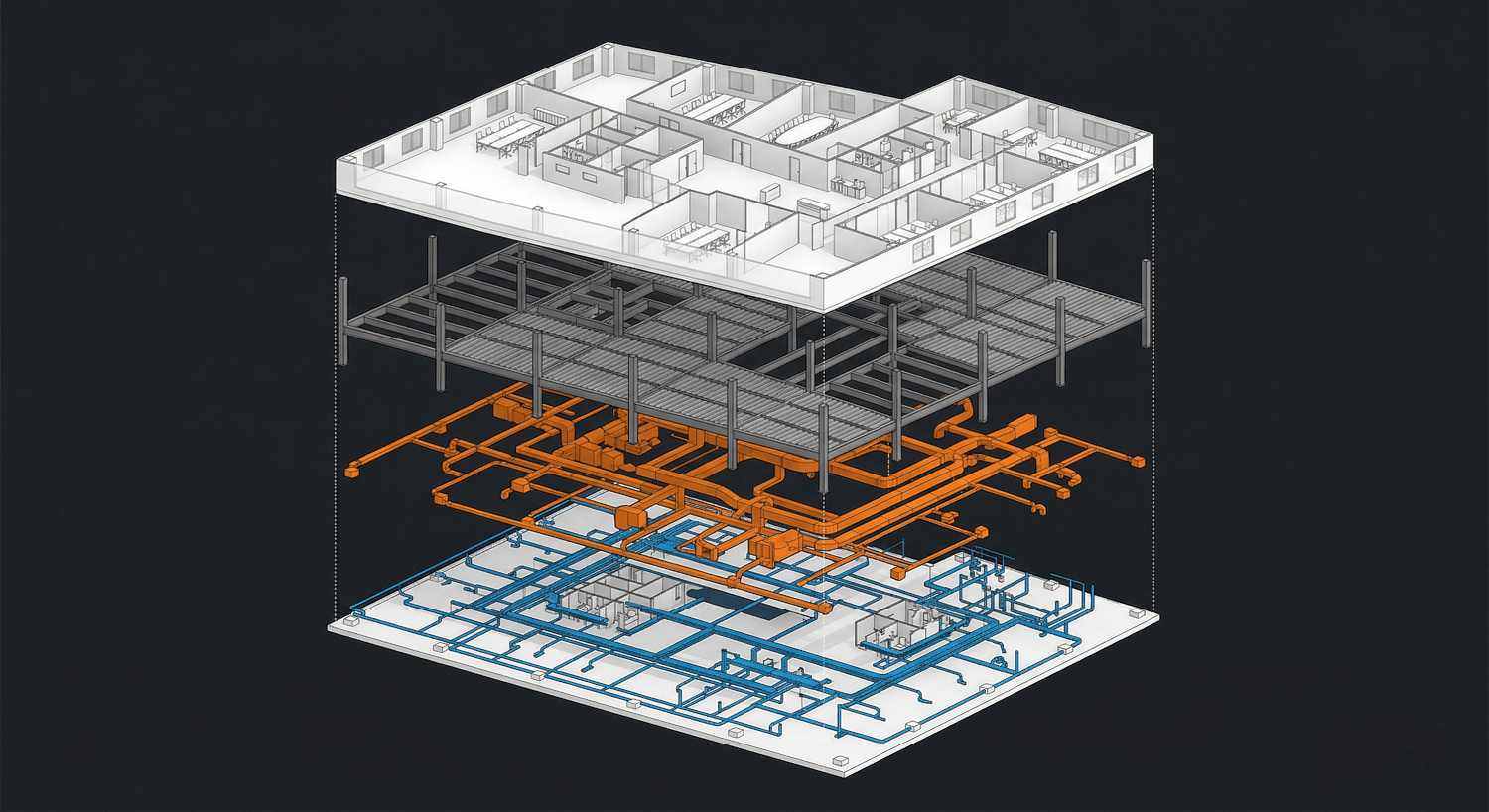
A coordinated MEP model at LOD 350 — mechanical, electrical, and plumbing systems routed and checked against structural and architectural elements before construction documentation is issued.
Mistake 3: Routing to Minimum Clearance
A model that passes hard-clash coordination is not necessarily a good model. One of the most persistent gaps between coordination sign-off and operational reality is maintainability clearance — the space needed around a valve, above a fan coil unit, beside a distribution board, or below a duct to allow the building services team to do their job after the building is occupied.
Pipes routed to a 10mm clearance from the slab above are technically clash-free. They are practically impossible to insulate, inspect, or repair without removing the ceiling grid and temporarily taking the system offline. Valves buried behind cable trays with no wrench clearance. Access doors that open into the face of a duct. These failures are invisible in a standard hard-clash test but make themselves known to facilities managers on day one of occupation.
The fix is two things. First, set clearance rules in the coordination brief before any routing begins — minimum 300mm above ducts for maintenance access, minimum 500mm in front of distribution boards, minimum access panel clearance for all concealed valves. Second, run clearance clash tests alongside hard-clash tests, not as an afterthought. At InfinevoD we include maintainability clearance checks as standard on every coordination package.
Mistake 4: Treating MEP as a Single Discipline
Mechanical, electrical, and plumbing are three distinct disciplines with different routing priorities, different trade sequences, and different installation requirements. Coordinating them as a single combined MEP model — rather than as three separate files coordinated against each other and against architecture and structure — is where the highest-volume clash category gets missed.
MEP-to-MEP clashes — ductwork versus cable tray, pipework versus conduit, drainage versus chilled water — consistently account for 40 to 50% of all hard clashes on a commercial project. They can only be found if each MEP sub-discipline is modeled and coordinated separately. On projects where the MEP model arrives as a single combined file, the coordination team cannot assign ownership of clashes correctly, cannot track which subcontractor is responsible, and cannot issue a meaningful BCF log that the site team can act on.
Already in coordination and hitting problems?
We can come in mid-programme, audit what exists, restructure the issue log, and reset the coordination process. It is faster than starting again and less painful than carrying the problem to site.
What Good MEP BIM Coordination Looks Like
A well-executed MEP BIM package arrives for coordination at the right LOD for the project stage, with mechanical, electrical, and plumbing modeled as separate discipline files, against the current architectural and structural revision, with maintainability clearances built into the routing rather than retrofitted after the clash report.
At InfinevoD we have run MEP coordination on over 200 projects where the initial model condition required significant restructuring before meaningful coordination could begin. We know what the problems look like and the fastest path to a clean model. If your current MEP coordination is producing long reports and short resolution rates, contact us.
Frequently Asked Questions
LOD 350 is the standard for construction coordination and clash detection. LOD 300 is acceptable for early design coordination. LOD 400 is for shop drawings and prefabrication packages only — it should not be required before routing is confirmed and coordination is complete.
Each subcontractor delivers their discipline model file separately to the CDE on an agreed exchange schedule. The coordination team federates them for clash testing. Clash ownership is assigned back to the responsible subcontractor via the BCF log. We manage this process routinely on any project with multiple MEP subcontractors.
Yes — and we do it regularly. We audit the existing model state, restructure the issue log if needed, agree resolution protocols with the project team, and reset the coordination programme from the current position. It is faster than starting again from scratch and stops more problems reaching site.
The Pattern Is Always the Same
Every MEP coordination failure we have seen traces back to one of the four issues above — wrong revision, wrong LOD, no maintainability clearance, or undivided MEP discipline structure. None of them are technically complex to fix. All of them are significantly cheaper to fix at model stage than on site.
If your MEP coordination is producing results that are not leading to clean, buildable documentation, contact InfinevoD. We offer a free model audit that identifies exactly which of these issues is present in your current files and what the fastest path to resolution looks like.