

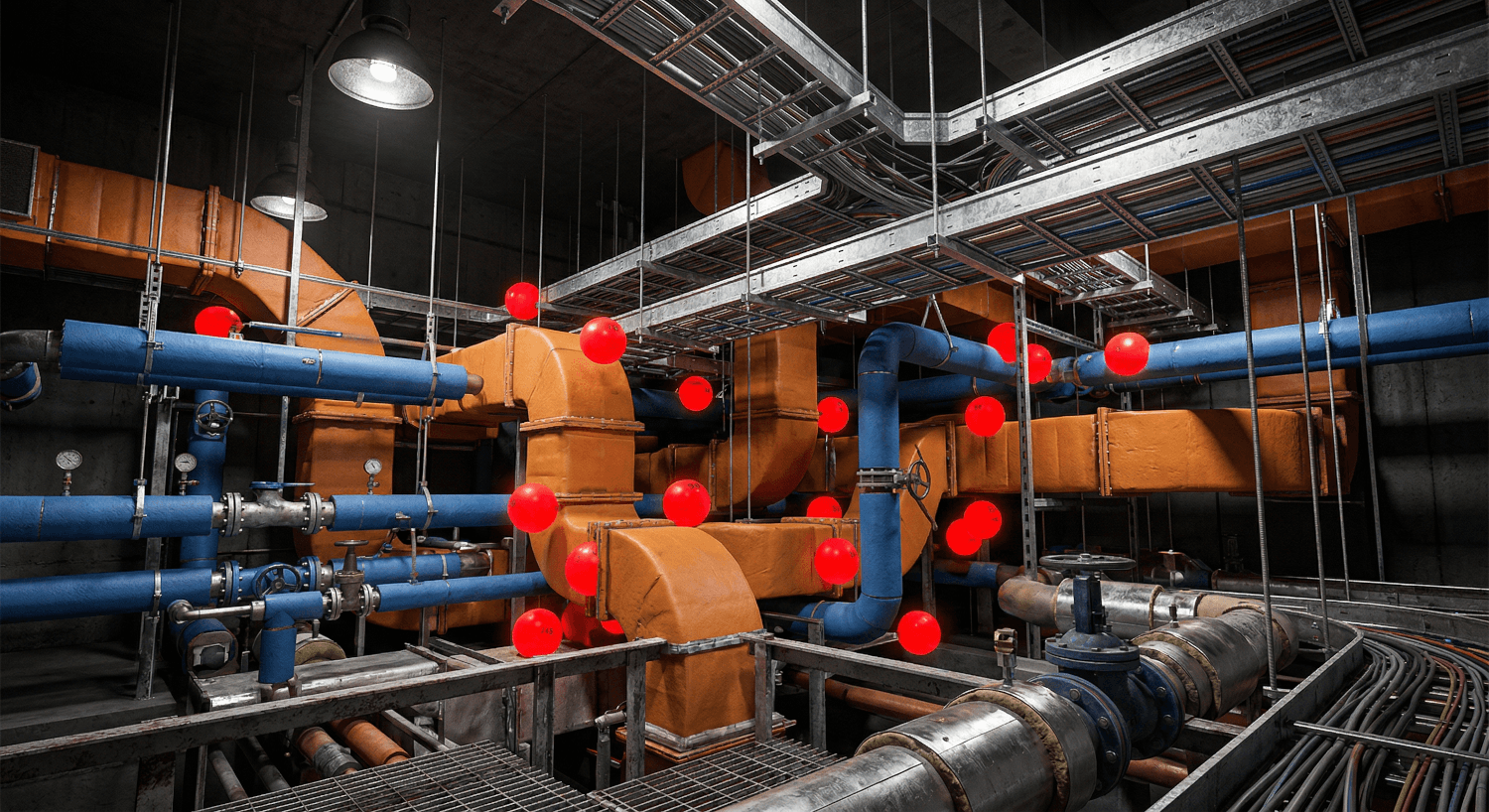
MEP systems are responsible for more construction coordination failures than any other discipline combination. On a typical commercial project, MEP-to-structural and MEP-to-MEP clashes account for 60 to 70% of all hard clashes found during coordination. This walkthrough covers exactly how those clashes are found, what the reports contain, and what happens from the moment the first issue log lands in your CDE.
This is not a guide to BIM theory. It is the process as it works on a live project — written for the project manager who needs to brief their team, evaluate a provider, or understand why the current coordination is not producing buildable results.
The Six Discipline Pairs That Matter
MEP clash detection is not a single test — it is a matrix of tests run across every combination of discipline pairs. On a standard commercial project, the six pairs that produce the most actionable clashes are:
| Discipline Pair | Typical Clash Volume | Most Common Conflict |
|---|---|---|
| Mechanical vs Structural | High | Duct runs through beams or columns |
| Electrical vs Structural | Medium | Cable tray routing through slab openings |
| Plumbing vs Structural | Medium | Drainage gradients conflicting with beam depths |
| Mechanical vs Electrical | Very High | Ductwork and cable trays competing for ceiling void |
| Mechanical vs Plumbing | Medium | Chilled water and heating pipe runs overlapping |
| Electrical vs Plumbing | Low – Medium | Conduit proximity to wet services |
Mechanical versus electrical is consistently the highest-volume MEP-to-MEP pair on dense commercial projects. It is also the one most frequently underweighted in coordination scope because both disciplines sit under the same MEP umbrella — teams assume they are already coordinated internally. They rarely are until someone tests them.
Hard Clash, Clearance Clash, Soft Clash
Hard clash: two elements physically occupy the same space in the model. A duct through a beam. A pipe through a column. These stop construction immediately if they reach site. Every hard clash in the coordination report is a site problem waiting to happen.
Clearance clash: two elements do not physically touch but are closer together than a specified minimum distance — wrench clearance for a valve, inspection access above a duct, regulatory separation between wet services and electrical. Clearance clashes pass a hard-clash-only test. They fail on site when a maintenance engineer cannot do their job.
Soft clash: an element is within a defined warning zone around another element. Soft clashes are advisory — they flag potential issues that need a human judgement call. Not every soft clash is a problem. But unreviewed, they become the clashes that fall through the gap between “passed coordination” and “works on site.”
Running MEP coordination and not getting clean results?
Send us your models. We run a free first-pass test across all six discipline pairs and return your prioritised issue log within 48 hours. No charge, no commitment.
What a BCF Report Actually Contains
BCF — BIM Collaboration Format — is the standard output of a clash detection exercise. A properly formatted BCF report is an actionable issue log that every discipline can open directly in their own BIM authoring tool without any conversion or interpretation.
- Clash ID and title — unique reference for tracking and audit trail purposes
- Camera view — exact viewpoint in the federated model so the responsible designer navigates directly to the issue
- Element IDs for both clashing objects — so the fix is made to the correct element in the correct model file
- Severity rating — critical, moderate, or advisory — so the project team can prioritise resolution against the programme
- Discipline ownership — which subcontractor is responsible, with no ambiguity about who acts
- Suggested resolution path — a practical recommendation for how the clash is fixed, not just a statement that it exists
- Status field — Open, In Review, or Resolved — updated through each cycle so the project manager can track progress without attending every coordination meeting
A BCF report that contains only clash IDs and camera views — with no element IDs, no ownership, and no resolution guidance — is a starting point, not a deliverable. If that is what your coordination provider is issuing, you are doing the harder half of their job for them.
What Happens After the Report Is Issued
The report goes into the project CDE. Each clash is assigned to the responsible discipline. The MEP subcontractor opens the issue in their BIM authoring software, resolves the routing conflict, and re-issues the updated model file.
The coordination team then runs the next clash cycle — reloading the updated models and comparing results against the previous run. This confirms reported clashes have been resolved and catches any new clashes introduced by the remediation. A MEP designer who moves a duct 300mm to clear a structural beam may inadvertently route it into a cable tray — that new clash only appears in the second cycle.
This cycle repeats — typically two to four rounds on a well-managed programme — until the model is clean. A coordination sign-off certificate is then issued confirming all hard and critical clearance clashes have been resolved. That certificate is what your QS references if any future on-site variation is claimed to be a coordination issue.
”The first time InfinevoD ran our coordination we had 340 clashes. By cycle three we had eleven — all soft clashes resolved before construction drawing issue. We had one coordination-related RFI on site, and it was something the MEP subcontractor changed after sign-off.”
— Project Manager, Commercial Development, UAE
Programme tighter than you would like?
We have run first-pass MEP clash reports in under 48 hours on fast-track projects. Tell us your programme and the current state of your models and we will confirm what is achievable.
Frequently Asked Questions
Two to four cycles on a well-managed project. Cycle one produces the highest clash volume. Cycle two catches remediations that introduced new conflicts. Cycles three and four are typically minor — cleaning up soft clashes and confirming the model is ready for construction drawing issue.
First report: 48 to 72 hours from model receipt. Each subsequent cycle: 24 to 48 hours from receiving updated discipline files. The rate-limiting factor is usually how quickly the responsible disciplines respond to open issues — not the detection itself.
MEP clash detection is one component of a full BIM Coordination package. BIM Coordination covers all discipline combinations including architectural and structural. MEP clash detection specifically focuses on mechanical, electrical, and plumbing systems and their interaction with each other and with the structural model. On projects where architectural coordination is already complete, an MEP-specific package is often the most efficient scope.
The Process Is Straightforward. The Discipline Is Not.
MEP clash detection is not technically complex. What requires genuine expertise is tolerance calibration, issue triage, resolution guidance, and the cycle management that turns a long clash list into a clean model. The difference between a coordination exercise that produces results and one that produces reports is in how the process is managed between the detection runs.
InfinevoD has run MEP clash detection on over 200 commercial, healthcare, and infrastructure projects. Our first-pass reports are delivered within 48 hours. If your MEP coordination is producing long reports and short results, contact us today.