

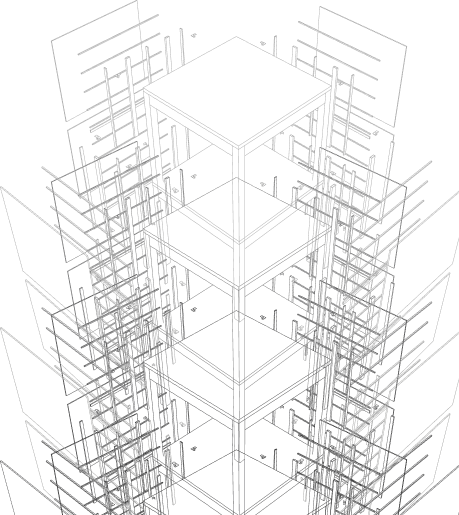
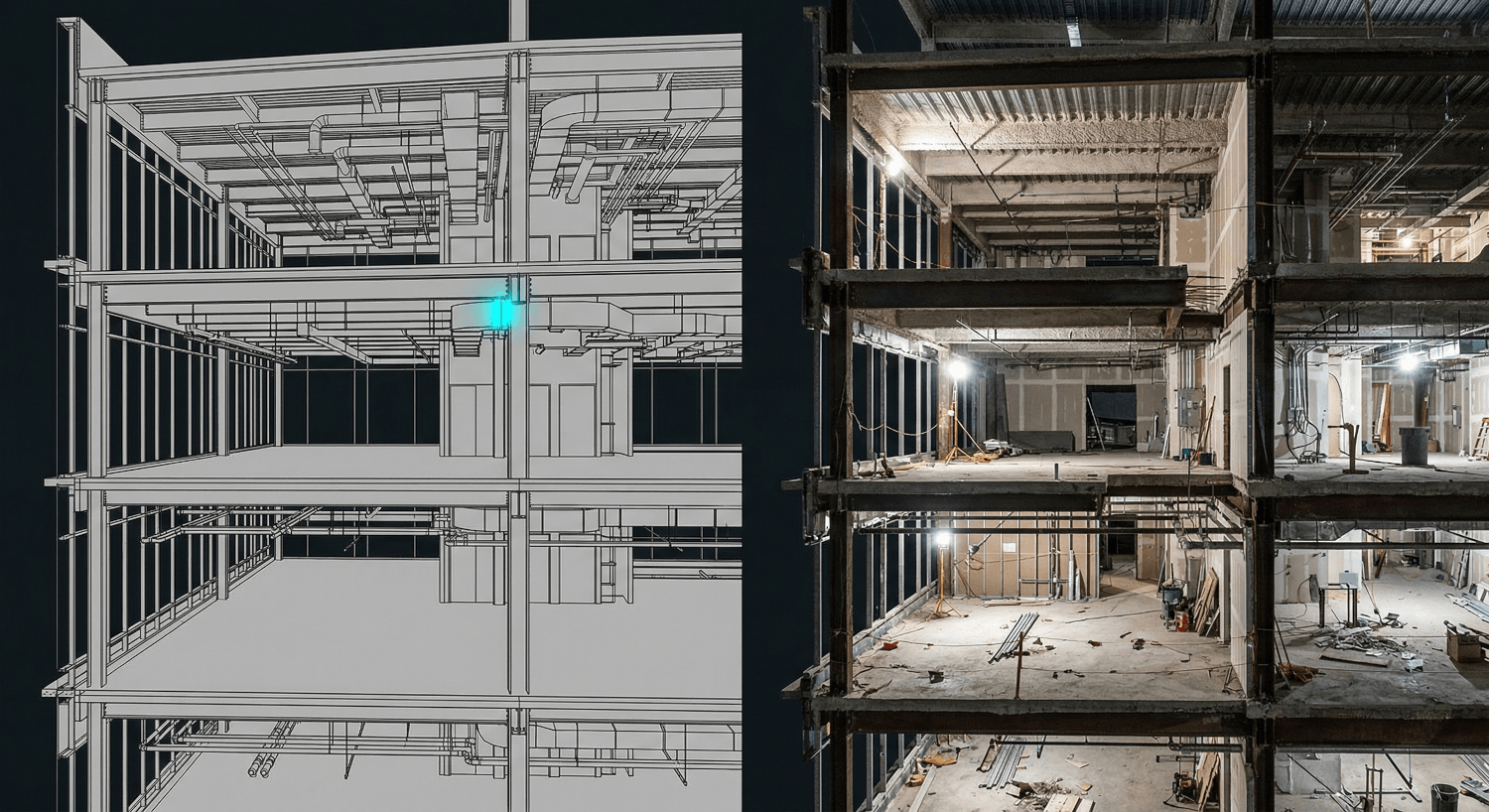
A clash found in the BIM model costs about £15 to resolve. A coordinator spots it, flags it in the BCF log, a designer moves the duct 150mm in Revit and re-issues the file. Fifteen minutes. Done. The same clash found on site — with trades mobilised, materials delivered, and scaffolding up — routinely costs between £8,000 and £60,000. On a single floor plate.
That is not a BIM industry talking point. It is a cost line that appears on variation schedules across the UK, Middle East, and Australia every week. The only difference between the projects that pay it and the projects that do not is whether someone federated the models before construction started.
This post breaks down exactly where the on-site number comes from, what the multiplier looks like across a full project, and what it actually costs to stop it happening.
Average cost to resolve a clash in the model
Average cost of a single hard clash found on site
The cost multiplier between model and site resolution
Where the £21,000 Figure Comes From
Take a single duct-versus-beam clash on a live commercial project. The MEP gang arrives on a Monday morning, starts threading ductwork, and hits a structural beam that was never in their routing plan. Here is what happens next, line by line.
The MEP gang stops. Twelve tradespeople at an average cost of £200 per person per day are now standing still. That is £2,400 per day — and these situations rarely resolve in a day. The site manager calls the structural engineer. The structural engineer calls the architect. Someone eventually calls the MEP designer. A redesign is commissioned. Allow two days minimum: £4,800 in idle time before a single drawing is issued.
The redesign and re-issue takes a senior engineer four hours at £90 per hour, plus internal review and reissue through the CDE: call it £1,800, plus three working days of lead time. While that is happening, the trades that follow the MEP gang — fire stopping, ceiling grid, floor screed — are queued up and waiting. Programme cascade begins.
The actual remediation — adjusting the routing, procuring additional materials, completing the installation — costs roughly £2,000 to £4,000 depending on system complexity. Add the site manager’s time across the episode: £1,200. Add the project manager’s time managing the variation: £800.
Subtotal before programme impact: £10,600 to £14,600. On a fast-track commercial project, one week of delay in a critical MEP zone costs £8,000 to £15,000 in knock-on contractor preliminaries alone — before the client starts discussing LADs.
Total for one clash: £18,600 to £29,600. Call it £21,000 as a conservative mid-point. Not worst-case. A normal, mid-complexity single clash on a mid-size commercial project.
One Clash Is Never One Clash
A typical mid-rise commercial project with no formal coordination history carries 200 to 400 hard clashes waiting to be discovered. Even if only 30% become active variations, that is 60 to 120 variations on a project where the contract sum might be £5M to £8M. At £21,000 average each, the uncoordinated rework budget sits between £1.26M and £2.52M. Against a coordination fee of £4,000 to £12,000.
| Project Size | Coordination Fee | Typical Rework Without Coordination | Net Saving |
|---|---|---|---|
| Up to 1,000m² | £2,000 – £4,000 | £40,000 – £120,000 | £36K – £116K |
| 1,000 – 5,000m² | £4,000 – £10,000 | £150,000 – £600,000 | £140K – £590K |
| 5,000m²+ | £10,000 – £30,000 | £600,000 – £2,000,000+ | £570K – £1.97M+ |
Indicative figures based on InfinevoD project data. GBP. Actual costs depend on project type, complexity, and programme.
Find Out What Your Models Are Hiding
Send us your files. We return your top clash risks within 48 hours — no charge, no commitment. Most clients are surprised by what turns up before a single slab is poured.
The Hidden Costs That Never Appear on a Variation Schedule
The numbers above are the visible costs — the ones that end up on a formal variation. There is another category that never gets invoiced but shapes every subsequent decision on a project and beyond it.
Client relationship damage. When a client sees three coordination-related variations in the first month of construction, they stop trusting the programme. Every subsequent update gets challenged. Every milestone gets scrutinised. The commercial relationship shifts from collaborative to adversarial, and it rarely fully recovers on that project.
Repeat work risk. The contractors who get called back for the next project are the ones whose last project ran clean. One badly coordinated project can cost you the renewal on a framework or the reference on a bid. That is a revenue impact that dwarfs the variation schedule.
Key person strain. Project managers who spend their days managing avoidable rework do not stay. The retention cost of replacing an experienced project manager sits between £15,000 and £40,000 when you include recruitment, onboarding, and the knowledge lost in the transition.
Five Questions to Ask Before You Hire a Coordination Provider
Not all coordination services are the same. Running a Navisworks clash test and generating a report is the easy part. What distinguishes a professional coordination service is what happens after the report is issued.
- Do you price hourly or on a fixed fee? Hourly pricing creates the wrong incentive — a long clash resolution cycle benefits the provider. Fixed fee aligns everyone.
- What does your BCF log include? Camera views, element IDs, severity ratings, and suggested resolution paths — or just a list of clash numbers.
- Do you chase resolution or just flag and return? The value is in tracking every issue to closure, not generating a long report and stepping back.
- Can you work in our CDE? BIM 360, ACC, Procore, Asite, or a shared drive — you should not need to change your workflow to get coordination done.
- What is your sign-off format? A coordination certificate your QS can reference against any future variation claim is what closes the loop properly.
Get a fixed-fee quote for your next project
Tell us the project type, approximate floor area, and number of discipline models. We run a free model audit and come back with a scope and fee within 24 hours. No hourly billing. No surprises.
Frequently Asked Questions
The core cost components are: idle trade time while the issue is diagnosed and redesigned, the redesign and re-issue cost, remediation materials and labour, site manager and project manager time, and programme knock-on. On a typical commercial project these combine to £8,000 minimum for a simple clash and £30,000 to £60,000 for a complex one affecting multiple trades and critical path items.
Yes — the cost-to-risk ratio improves on smaller projects because the coordination fee scales down faster than the potential rework cost. A £3,000 coordination package on a 600m² fit-out still protects against £40,000 to £120,000 in rework exposure. We do projects from £1,500 upwards.
Earlier is always better. We can run coordination on works-in-progress models and flag incomplete or missing areas as part of the audit. The most expensive clashes are always the ones caught after construction starts — even a partial model review has real value.
The Only Question That Matters
The ROI on BIM coordination is not complicated. The coordination fee is a known fixed cost. The rework exposure is an unknown variable that historical data puts at 8 to 15% of contract value on uncoordinated projects. Every project manager who has been through one rework-heavy scheme would pay the coordination fee ten times over to avoid repeating it.
InfinevoD has delivered BIM coordination on over 500 projects across residential, commercial, healthcare, and infrastructure. We start within 5 working days. Every engagement begins with a free model audit — no cost, no obligation.